Overriding an Existing Page with a Visualforce Page
Suppose you want to change the format of an existing page, such as the standard account detail page. All the information for an account displays on a single page. If there's a lot of information, you might end up doing a lot of scrolling. Using a Visualforce page you can make each section for an account display in a tab, such as contacts, opportunities, and so on.
First, create a new Visualforce page using the quick fix.
- In your browser, add the text /apex/tabbedAccount to the URL for your Salesforce instance. For example, if your Salesforce instance is https://na1.salesforce.com, the new URL would behttps://na1.salesforce.com/apex/tabbedAccount. You will get the following error message:
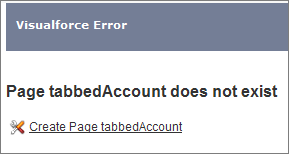
- Click Create Page tabbedAccount to create the new page.
- Click the Page Editor link in the bottom left corner of the page. This displays the code for the new page, which should look like this:
<apex:page>
<!-- Begin Default Content REMOVE THIS -->
<h1>Congratulations</h1>
This is your new Page: tabbedAccount
<!-- End Default Content REMOVE THIS -->
</apex:page>
4.Replace the existing code with the following and click Save:
<apex:page standardController="Account" showHeader="true"
      tabStyle="account" >
   <style>
      .activeTab {background-color: #236FBD; color:white;
         background-image:none}
      .inactiveTab { background-color: lightgrey; color:black;
         background-image:none}
   </style>
   <apex:tabPanel switchType="client" selectedTab="tabdetails"
                  id="AccountTabPanel" tabClass='activeTab'
                  inactiveTabClass='inactiveTab'>
      <apex:tab label="Details" name="AccDetails" id="tabdetails">
         <apex:detail relatedList="false" title="true"/>
      </apex:tab>
      <apex:tab label="Contacts" name="Contacts" id="tabContact">
         <apex:relatedList subject="{!account}" list="contacts" />
      </apex:tab>
      <apex:tab label="Opportunities" name="Opportunities"
                id="tabOpp">
         <apex:relatedList subject="{!account}"
                           list="opportunities" />
      </apex:tab>
      <apex:tab label="Open Activities" name="OpenActivities"
                id="tabOpenAct">
         <apex:relatedList subject="{!account}"
                           list="OpenActivities" />
      </apex:tab>
      <apex:tab label="Notes and Attachments"
                name="NotesAndAttachments" id="tabNoteAtt">
         <apex:relatedList subject="{!account}"
                           list="CombinedAttachments" />
      </apex:tab>
   </apex:tabPanel>
</apex:page>
5. Notice that there is no data in the Account page. You need to specify the ID of a
particular account in the URL, as you've done with previous pages, for example,
https://Salesforce_instance/apex/tabbedAccount?id=001D000000IRt53. After you add in an account ID,
your page should display as follows:Things to note about the page markup:
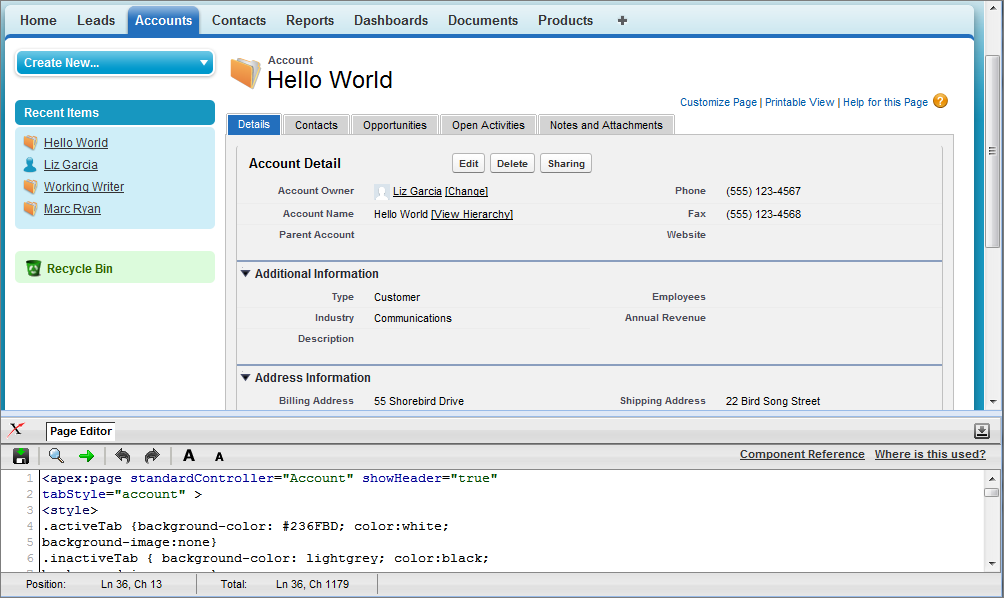
- <style> is actually part of CSS markup, not Visualforce markup. It defines the styles for two types of tabs: activeTab and inactiveTab.
- <apex:tabPanel> is used to generate the tabs. Notice how it uses the following attributes:
- tabClass attribute: specifies the style class used to display a tab when it is active.
- inactiveTabClass attribute: specifies the style class used to display a tab when it is inactive.
- Within the definition of the tab panel, is the definition of each child tab component, <apex:tab>. The first tab uses the<apex:detail> tag to return that portion of the detail view for the page:
<apex:tab label="Details" name="AccDetails" id="tabdetails">
   <apex:detail relatedList="false" title="true"/>
</apex:tab>
While the rest of the tabs use the <apex:relatedList> to specify the different parts of the account page. The following is the tab for contacts. It uses an existing list of contacts.
<apex:tab label="Contacts" name="Contacts" id="tabContact">
   <apex:relatedList subject="{!account}" list="contacts" />
</apex:tab>
Now that you've created a page to display an account with tabs, you can use this page to override the detail view for all accounts.
- From the object management settings for accounts, go to Buttons, Links, and Actions.
- Click Edit next to View.
- In the Salesforce Classic section, select Visualforce page.
- From the Visualforce page drop-down list, select tabbedAccount.
- Click Save.
Click the Account tab, and select any account. The detail for the account is now displayed with tabs.

No comments:
Post a Comment